Field Notes
Strait Risk, LNG Routing, and the Energy Decision Window

On 4 March 2026, Iran closed the Strait of Hormuz. Before the end of that week, QatarEnergy had declared force majeure on long-term LNG contracts with customers in Italy, Belgium, South Korea, and China.1 European gas prices rose 63% within days. Asian spot prices rose 54%.2 US domestic prices rose 7%. The three-way divergence was not random. It traced precisely to who held LNG supply arrangements that bypassed the Strait of Hormuz and who had not made those arrangements, and when. The decisions that produced that divergence were made months and years earlier, inside windows that had already closed by the time the crisis began.
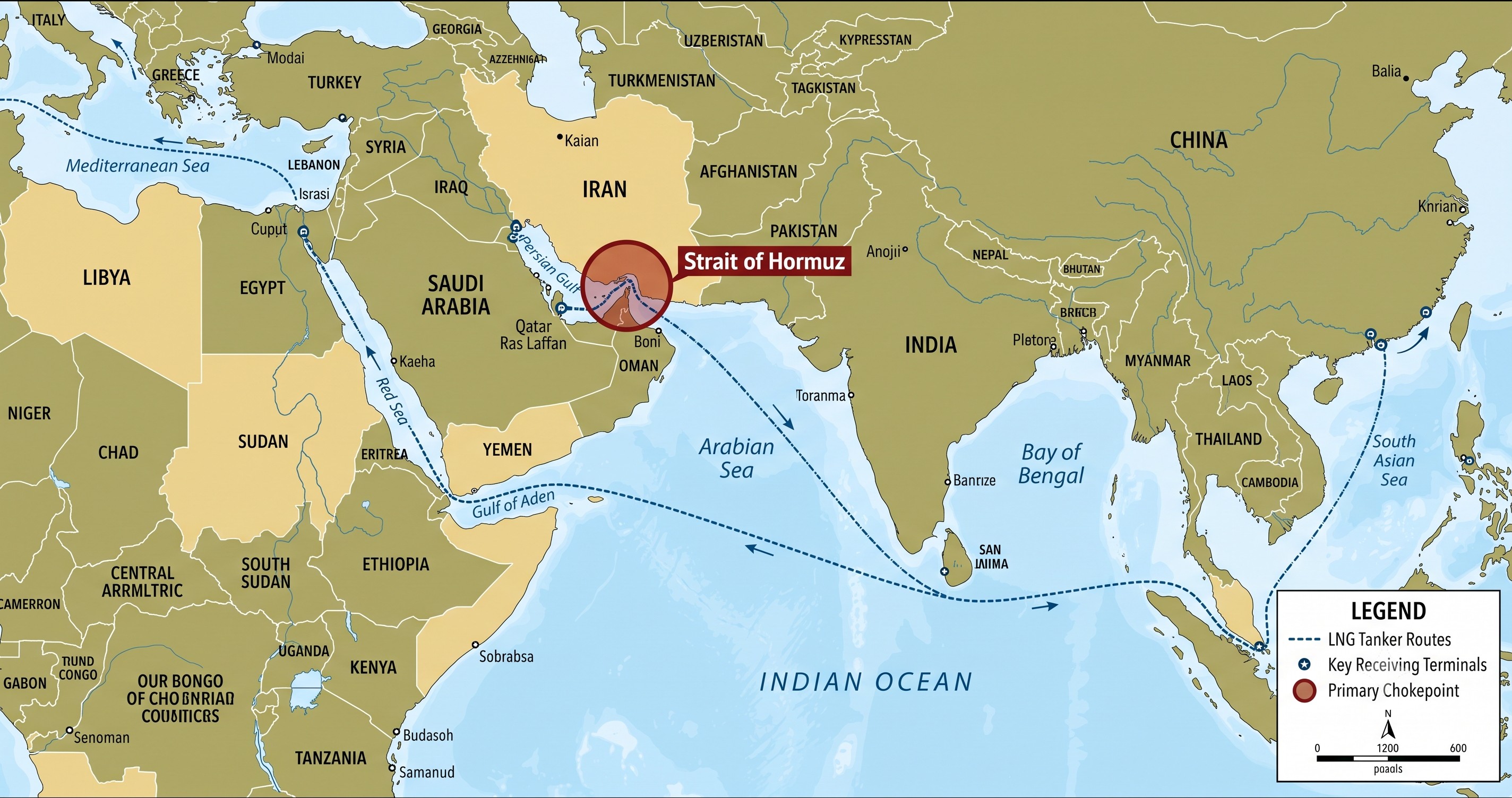
The chokepoint and what moved through it
Before the March 2026 closure, approximately 20% of global seaborne LNG trade and roughly 25% of global seaborne oil transited the Strait of Hormuz.3 About 93% of Qatar's LNG exports and 96% of UAE LNG exports passed through the Strait — together representing 19% of global LNG trade.4 Nearly 90% of the LNG transiting the Strait was destined for Asian buyers.4
The exposure was not evenly distributed. Japan's LNG import dependence on Hormuz transit was approximately 6.3%, with its largest supply sources being Australia (39.7%), Malaysia (14.8%), and Russia (8.9%), none of which transit the Strait.5 Japan had spent the decade following Fukushima systematically diversifying its LNG import geography specifically to reduce Gulf concentration. As a result, when the crisis began, Japan's largest power utility JERA had secured sufficient LNG supply to cover domestic demand through July 2026 through its pre-positioned alternative supply arrangements.6
Bangladesh, India, and Pakistan imported almost two-thirds of their total LNG supply via the Strait of Hormuz in 2025.4 They had no equivalent pre-positioned alternative. That asymmetry — Japan insulated, South Asian importers fully exposed — was not produced by the crisis. It was produced by decisions made before it.
The European concentration trap
The most analytically important exposure in March 2026 was not where most attention fell. European buyers had signed a wave of long-term Qatar LNG contracts specifically between 2021 and 2023, explicitly as an alternative to Russian pipeline gas following Russia's invasion of Ukraine. France's TotalEnergies signed a 27-year, 3.5 million tonnes per annum agreement with QatarEnergy. Germany's ConocoPhillips signed a 15-year, 2 million tonne per annum agreement.7 These were deliberate, board-approved decisions to reduce geographic concentration risk on Russia.
The Columbia University Center on Global Energy Policy noted in research from this period that Qatar's reserves — at 23.8 trillion cubic metres — are entirely concentrated in a single geographic location, creating significant supply concentration risk for European and global markets.7 A European energy buyer that signed a 27-year Qatar LNG contract in 2022 was reducing Russian dependence and increasing Hormuz exposure in the same transaction. Whether that trade-off was modelled before the contracts were signed is the operative question. The evidence from March 2026 — European buyers among those receiving QatarEnergy force majeure notices — suggests it was not adequately stress-tested.
19% of global LNG trade transited the Strait of Hormuz before the March 2026 closure. European buyers who signed long-term Qatar contracts to replace Russian pipeline gas traded one geographic chokepoint for another.4
The energy decision window defined
The energy decision window is the interval between a geopolitical trigger event and the point at which all practical alternatives for supply sourcing, contract adjustment, and routing change have been foreclosed by commercial, logistical, or regulatory constraints.
For LNG, this window is narrow and asymmetric. QatarEnergy declared force majeure on 24 March 2026, twenty days after the Strait closed.1 But the operational decision window for most buyers had effectively closed before the force majeure declaration — the moment physical supply options foreclosed, not the moment they were formally notified. Spot LNG cargo bookings require commercial relationships and lead time. Alternative supply from Australian, US, or Malaysian producers requires existing take-or-pay arrangements and LNG carrier availability. None of that infrastructure can be assembled after the Strait is already closed.
The Institute of Energy Economics, Japan (IEEJ) published a Special Bulletin in March 2026 documenting that the Hormuz crisis "constitutes an unprecedented event in which exports from the Middle East — accounting for approximately 20 percent of global LNG supply — have been lost" and described it as "a severe supply shock affecting both crude oil and LNG."8 The IEEJ had been modelling Hormuz closure scenarios since at least the late 1990s, reflecting Japan's chronic awareness of its crude oil exposure (93.5% Middle East dependent) despite its more diversified LNG position. The analytical infrastructure was present in Japan. It was less evident in the European risk functions that had signed multi-decade Qatar contracts.
Why rerouting does not solve the LNG problem
During the Red Sea crisis that began in late 2023, container shipping companies rerouted vessels around the Cape of Good Hope, adding approximately 11,000 nautical miles, ten additional transit days, and roughly $1 million in extra fuel costs per voyage.9 That option — expensive, slow, but operationally available — does not exist for LNG from the Gulf in a Hormuz closure scenario.
Saudi Arabia was able to divert some crude oil volumes through the East-West Pipeline to the Yanbu terminal on the Red Sea following the March 2026 closure.10 No equivalent pipeline infrastructure exists for LNG. The Ras Laffan complex, which is the world's largest LNG liquefaction facility, can only export through the Gulf. It cannot be rerouted. It can only stop.
The Ras Laffan complex was struck by Iranian forces on 18 March 2026, seventeen days after the Strait closed.10 The attack caused a 17% reduction in Qatar's LNG production capacity, with repair timelines estimated at three to five years for the most damaged infrastructure.11 QatarEnergy began equipment testing from April 2026, establishing a six-to-eight-week pre-positioning window before any production restart could follow a Hormuz reopening.12 The IEEJ April 2026 Special Bulletin estimated that in a post-summer restart scenario, the cumulative loss of LNG supply would reach 74 billion cubic metres against the pre-war reference case — approximately 18% of 2025 global LNG trade volumes.8
The decision window that already closed
The most actionable framing of the energy decision window concept is not about what to do when a crisis starts. It is about which decisions, made years before a crisis, determine what options you have when the crisis window opens.
Japan's relative insulation in March 2026 was not a response to the crisis. It was the product of decisions made between 2011 and 2023 — post-Fukushima LNG diversification strategy, long-term supply agreements with Australian and US producers, and explicit company-level risk governance on Gulf concentration. JERA's ability to secure supply through July 2026 did not happen in March 2026. It happened when JERA signed the contracts and built the commercial relationships that made that security possible.6
The European buyers who received QatarEnergy force majeure notices in late March 2026 made their decisions during the 2021-2023 contract-signing window. The Oxford Institute for Energy Studies had published its Hormuz closure scenario paper in June 2025 — nine months before the crisis — modelling the exact sequence that followed.13 The analysis was available. Whether it was in the room when those 27-year contracts were signed is the governance question.
Closing
For energy sector CROs and procurement officers, the practical implication is this: the energy decision window is not only the 48-72 hours after a chokepoint closes. It is also the contract-signing session where supply concentration for the next decade is determined, the annual risk review where Hormuz scenarios should appear as named scenarios rather than background assumptions, and the supplier negotiation where destination-clause flexibility either is or is not built in. The window for those decisions does not open when the crisis starts. It opens well before, and it closes quietly.
Meridian's methodology for energy supply chain chokepoint monitoring, decision-window trigger mapping, and LNG contract exposure assessment is documented on the methodology page.
Footnotes
-
QatarEnergy declares force majeure on some LNG contracts due to Iran war. Al Jazeera, 24 March 2026. https://www.aljazeera.com/news/2026/3/24/qatarenergy-declares-force-majeure-on-some-lng-contracts ↩ ↩2
-
Wikipedia, "2026 Iran war fuel crisis." Accessed June 2026. https://en.wikipedia.org/wiki/2026_Iran_war_fuel_crisis ↩
-
International Energy Agency, "Strait of Hormuz." https://www.iea.org/about/oil-security-and-emergency-response/strait-of-hormuz ↩
-
IEA/EIA via Arab Reform Initiative, "Hormuz Under Fire: LNG Disruption, Regional Exposure, and Energy Sovereignty in MENA," 2026. https://www.arab-reform.net/publication/hormuz-under-fire-lng-disruption-regional-exposure-and-energy-sovereignty-in-mena/; EIA Press Release, "Hormuz closure and related production outages are key drivers in EIA's latest forecast," 7 April 2026. https://www.eia.gov/pressroom/releases/press586.php ↩ ↩2 ↩3 ↩4
-
IEEJ March 2026 Special Bulletin, "Japan's Energy Security Severely Shaken by the De Facto Blockade of the Strait of Hormuz." https://eneken.ieej.or.jp/data/13118.pdf ↩
-
Argus Media, "Japan's Jera Secures LNG Supplies Through July," 2026. https://www.argusmedia.com/en/news-and-insights/latest-market-news/2819216-japan-s-jera-secures-lng-supplies-through-july ↩ ↩2
-
Columbia University Center on Global Energy Policy, "Qatar's Contract Quandary," 2025; "How Qatar's LNG Decisions Will Impact an Oversupplied Global Market," September 2025. https://www.energypolicy.columbia.edu/qatars-contract-quandary/; https://www.energypolicy.columbia.edu/publications/how-qatars-lng-decisions-will-impact-an-oversupplied-global-market/ ↩ ↩2
-
IEEJ March 2026 Special Bulletin, op. cit.; IEEJ April 2026 Special Bulletin. https://eneken.ieej.or.jp/data/13198.pdf ↩ ↩2
-
Atlas Institute for International Affairs, "The Red Sea Shipping Crisis (2024-2025)," 2025. https://atlasinstitute.org/the-red-sea-shipping-crisis-2024-2025-houthi-attacks-and-global-trade-disruption/ ↩
-
Wikipedia, "2026 Strait of Hormuz crisis." Accessed June 2026. https://en.wikipedia.org/wiki/2026_Strait_of_Hormuz_crisis ↩ ↩2
-
Wikipedia, "2026 Iran war fuel crisis," op. cit. ↩
-
Discovery Alert, "Qatar LNG Production Restart After Strait of Hormuz Reopening 2026." https://discoveryalert.com.au/qatar-lng-restart-strait-hormuz-global-energy-markets/ ↩
-
Oxford Institute for Energy Studies, "Closing the Strait of Hormuz: Impact on the Global Gas Market," June 2025. https://www.oxfordenergy.org/publications/closing-the-strait-of-hormuz-impact-on-the-global-gas-market-2/ ↩
About the author
Shekhar Attri, Co-Founder & CTO. An Indian Army Special Forces veteran with 21 years of service and a gallantry medal, Shekhar's corporate security advisory work spans Singapore, India, the Philippines, and the UAE, alongside PhD research on machine intelligence under incomplete information.