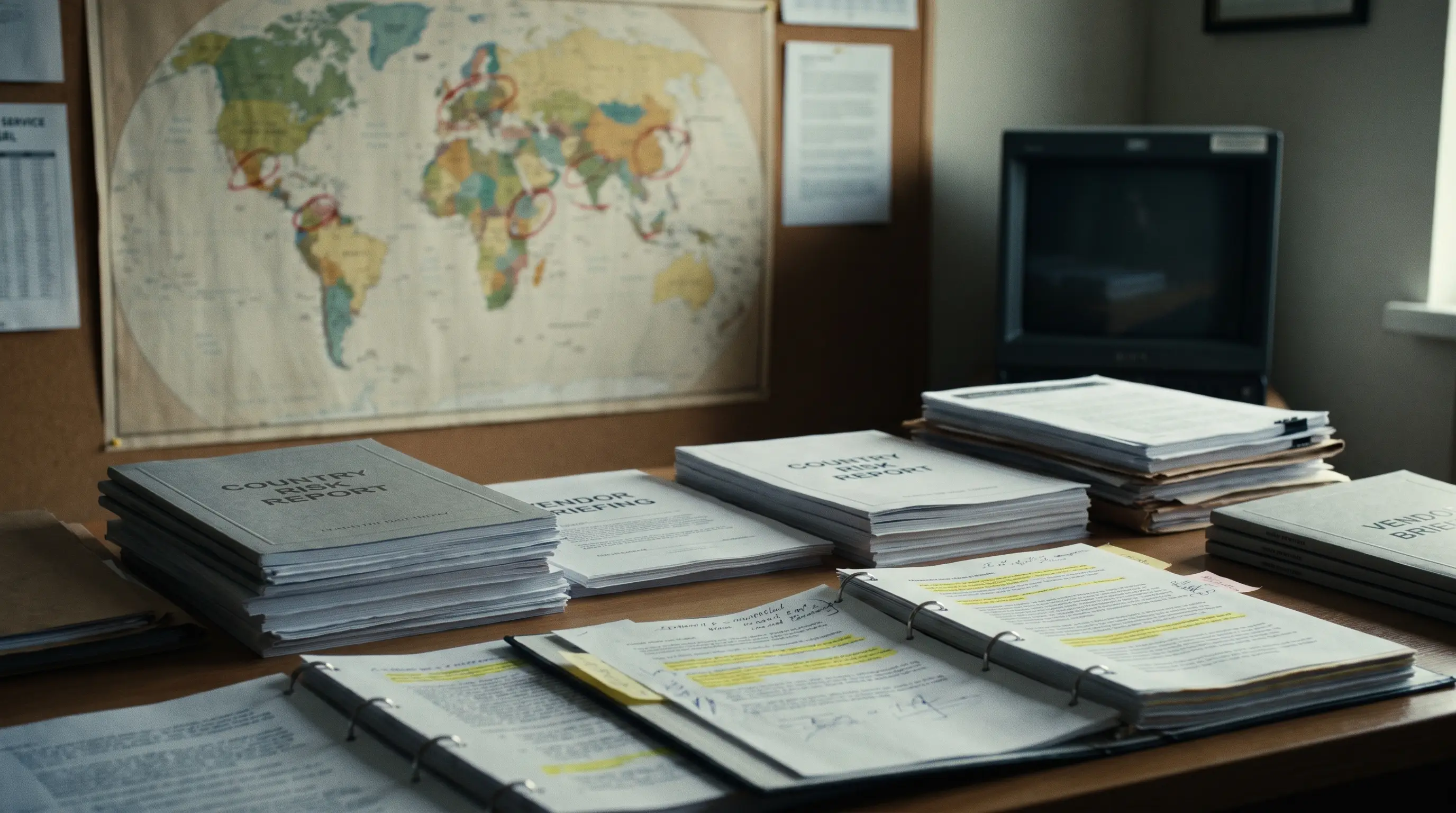
Field Notes
Why Country Risk Reports Fail CROs

The Strait of Hormuz closed on 4 March 2026. Within seventy-two hours, QatarEnergy had declared force majeure on long-term LNG contracts with customers in Italy, Belgium, South Korea, and China.1 Any chief risk officer who arrived at their desk that Monday with a current-quarter country risk score for Qatar and an Iran assessment from a standard vendor had already missed every decision that mattered. This is not a technology failure or a sourcing gap. It is a structural mismatch between what country risk reports are designed to produce and what an operating decision-maker actually needs when a risk turns into a decision. What the standard product was built for The main country risk vendors — EIU, Moody's Analytics, S&P Global Market Intelligence, Control Risks, and Verisk Maplecroft — produce a legitimate and defensible product. They consolidate macroeconomic, political stability, regulatory, and operational risk variables into scored assessments intended to help organizations understand which markets carry structural risk over multi-year planning horizons. For market-entry decisions made well in advance of operational exposure, they do what they say on the label. The problem is not what these products are. It is what they are purchased to do. In October 2024, 96% of chief risk officers surveyed by the World Economic Forum expected continued instability in geopolitical and geoeconomic relations between major economies in the coming twelve months.2 Most were tracking that instability through exactly the same product architecture that had existed for two decades, and most were reporting the outputs of that architecture to boards that had also just named geopolitical risk as their top concern for the first time.3 A Springer Nature academic review published in 2024 found significant divergence between academic best practices for country risk mapping and the methodology deployed by industry practitioners, particularly in how risk categories are aggregated into composite scores.4 The aggregation problem is not minor. A single country score that blends political stability, regulatory quality, infrastructure risk, and conflict exposure into one number loses precisely the granularity that a CRO needs when a specific asset class, corridor, or counterparty is under pressure. Three structural failures at the decision moment There are three reasons a standard country risk report fails when a CRO is facing a live operational decision, and each is structural rather than incidental. The first is lag. A quarterly report carries a publication date. The data feeding its analysis was cut off weeks before that date, and the analysis was written days before the cutoff. By the time a revised country risk score reflects changed conditions, decisions in the real world have already been made or missed. During the Red Sea crisis that began in late 2023, Houthi attacks drove rerouting decisions within hours of each incident. Container freight rates on Asia-Europe routes rose more than 80% against the January-October 2023 baseline.5 No quarterly assessment update matched that velocity. The second is geographic aggregation. A country risk report scores a sovereign jurisdiction. The operational decisions a CRO faces almost never concern a country. They concern a port, a production facility, a specific shipping corridor, or a named counterparty. A "High Risk" designation for Yemen does not tell you whether the transit lane at 13°N 43°E is active. An Iran risk score does not tell you which of Qatar's LNG production trains at Ras Laffan is operational following a strike. The unit of analysis in the report and the unit of analysis in the decision are different things. The third is backward orientation. A country risk assessment describes conditions as they currently stand. It is not architected to model what a combination of near-term factors is about to produce. A product that alerts a CRO when a threshold is about to be crossed is a different product from one that describes where the threshold currently sits. The forecasting problem no one names There is a fourth failure that almost no procurement conversation touches. Philip Tetlock's Good Judgment Project, which ran under a formal commission from IARPA — the US intelligence community's research arm — found that structured probabilistic forecasters (Superforecasters) were consistently 30% more accurate on geopolitical predictions than intelligence analysts working with access to classified information.6 The Superforecasters used no proprietary data. They used publicly available information, systematic probability calibration, and structured adversarial review of their own assumptions. Standard country risk scores use none of these techniques. They do not assign probabilities to discrete outcomes. They do not run adversarial challenges on their own assumptions. They do not measure or publish their predictive accuracy over time against a verifiable baseline. They describe current conditions, which is a legitimate function. They do not forecast, which is the function CROs increasingly need.
Superforecasters were 30% more accurate than intelligence analysts with access to classified information in a four-year IARPA-commissioned tournament. Standard country risk vendors publish no equivalent accuracy data.6
Why the incentive structure perpetuates the mismatch The country risk report has an incentive architecture problem. Its principal customer is not the CRO making a live operational decision. Its principal customer is the audit committee verifying that geopolitical risk was correctly identified and disclosed in the annual report. That customer needs backward-looking documentation of risk identification, not forward-looking decision intelligence. The product serves that customer well. Verisk Maplecroft has observed that "emerging disruptions go unnoticed until they impact assets or supply chains" within many organizations.7 That is not a failure of vendor intelligence. It is a description of what happens when the organizational consumer of that intelligence — the risk function — is structured to receive situation reports and produce compliance disclosures, not to convert intelligence into decision lead time. The WEF October 2024 data is explicit on this: 95% of CROs expect risk functions to contribute to shaping organizational strategy.2 That expectation cannot be met by a product designed to satisfy an audit trail. The March 2026 test case The Ras Laffan industrial complex was struck by Iranian forces on 18 March 2026, seventeen days after the Hormuz closure began.8 The attack produced a 17% reduction in Qatar's LNG production capacity, with repair timelines estimated at three to five years for the most heavily damaged infrastructure.9 The Oxford Institute for Energy Studies had published a scenario paper in June 2025 modelling precisely this sequence — Hormuz closure plus Ras Laffan damage — nine months before it occurred.10 That analysis was in the public domain. The gap was not analytical. It was the distance between analysis that existed and the risk functions whose procurement decisions had not brought it into their operational intelligence stack. A CRO asking their standard vendor "what is Qatar's country risk score?" on 3 March 2026 received an answer that had nothing to say about the following three weeks. A CRO whose intelligence function was tracking Iranian military doctrine, Ras Laffan facility vulnerability, and QatarEnergy force majeure precedent had a different set of options when the same three weeks began. What decision-grade intelligence requires Intelligence that serves a CRO decision has four characteristics that standard country risk reports rarely provide. It names specific assets, corridors, and counterparties rather than scoring jurisdictions. It is time-aware — reaching the relevant person within hours of a trigger, not weeks. It is decision-framed: not "Iran remains elevated" but "the following contractual positions carry near-term exposure under current conditions, and the following must be decided by [date]." And it is sourced — every material claim traces to a verifiable primary reference that can be examined, contested, and updated. The audit question is simple: when did your last intelligence product reach your desk, and would it have given you 48 hours of lead time on a decision that needed to be made in 48 hours? If the answer is no, the problem is not the quality of the report. It is the architecture of the product and the incentive structure of the function that procures it.
Meridian's source selection methodology, geopolitical risk trigger classification framework, and decision-window mapping approach are documented on the methodology page. Footnotes
QatarEnergy declares force majeure on some LNG contracts due to Iran war. Al Jazeera, 24 March 2026. https://www.aljazeera.com/news/2026/3/24/qatarenergy-declares-force-majeure-on-some-lng-contracts ↩
World Economic Forum, Chief Risk Officers Outlook: October 2024. Geneva: WEF, October 2024. https://www.weforum.org/publications/chief-risk-officers-outlook-october-2024/ ↩ ↩2
National Association of Corporate Directors, NACD 2025 Governance Outlook. Washington DC: NACD, 2025. https://www.nacdonline.org/all-governance/governance-resources/trending-oversight-topics/geopolitical-risk ↩
Springer Nature, "Country risk mapping in a changing world — comparative survey on academic research and industrial practices." International Journal of System Assurance Engineering and Management, 2024. https://link.springer.com/article/10.1007/s13198-024-02600-8 ↩
Atlas Institute for International Affairs, "The Red Sea Shipping Crisis (2024-2025): Houthi Attacks and Global Trade Disruption," 2025. https://atlasinstitute.org/the-red-sea-shipping-crisis-2024-2025-houthi-attacks-and-global-trade-disruption/ ↩
Good Judgment Inc, "About Superforecasting." https://goodjudgment.com/about/; Philip Tetlock and Dan Gardner, Superforecasting: The Art and Science of Prediction (Crown, 2015). ↩ ↩2
Verisk Maplecroft, "Country Risk Data for Global Business." https://www.maplecroft.com/data/country-risk-data/ ↩
Wikipedia, "2026 Strait of Hormuz crisis." Accessed June 2026. https://en.wikipedia.org/wiki/2026_Strait_of_Hormuz_crisis ↩
Wikipedia, "2026 Iran war fuel crisis." Accessed June 2026. https://en.wikipedia.org/wiki/2026_Iran_war_fuel_crisis ↩
Oxford Institute for Energy Studies, "Closing the Strait of Hormuz: Impact on the Global Gas Market." OIES Energy Comment, June 2025 (reissued March 2026). https://www.oxfordenergy.org/publications/closing-the-strait-of-hormuz-impact-on-the-global-gas-market-2/ ↩
About the author
Jay Bimbrah, Co-Founder & COO. A former Scotland Yard counter-terrorism investigator, Jay has advised EMEA tier-1 banks and Lloyd's market firms on distinguishing real exposure from theoretical risk.